

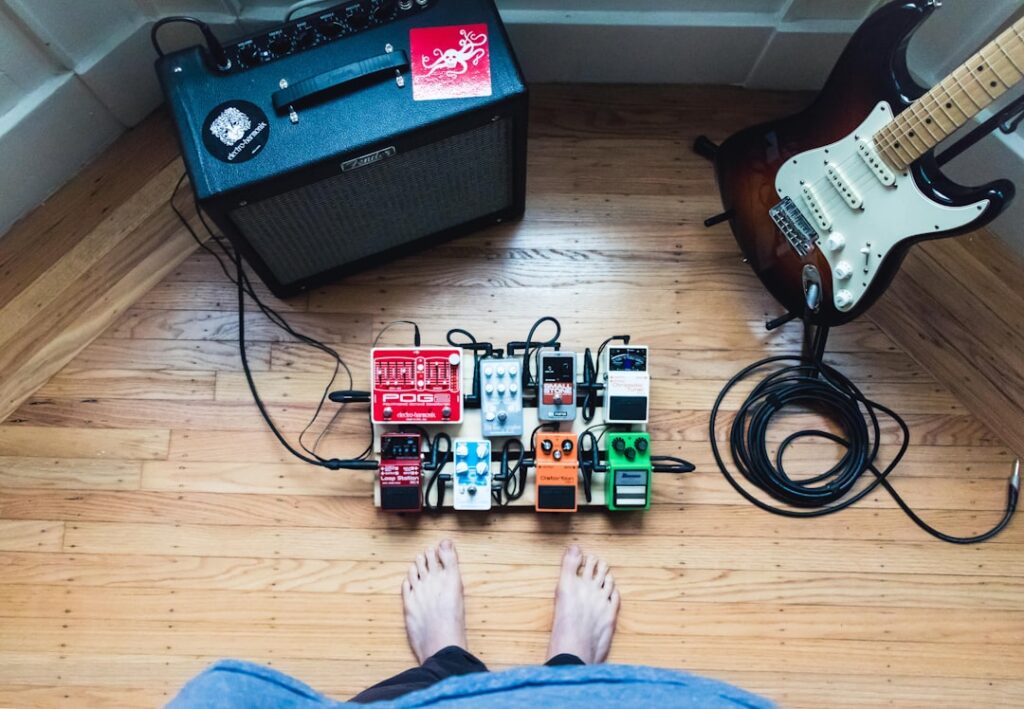
The electric guitar is a versatile and popular instrument that has played a significant role in shaping the sound of modern music. Its history dates back to the early 20th century when inventors and musicians began experimenting with amplifying the sound of the traditional acoustic guitar. The first commercially successful electric guitar was introduced in the 1930s by the company Rickenbacker, and since then, it has become an essential instrument in various genres such as rock, blues, jazz, and more.
The electric guitar consists of several parts that work together to produce its unique sound. The body is typically made of solid wood or a combination of wood and other materials, and it houses the pickups, which are magnets that capture the vibrations of the strings and convert them into electrical signals. These signals are then sent to an amplifier, which amplifies the sound and allows it to be heard at higher volumes.
There are various types of electric guitars available, each with its own distinct characteristics. The most common type is the solid-body electric guitar, which has a solid body and is known for its versatility and durability. Other types include semi-hollow body guitars, which have a hollow chamber in addition to a solid body, and hollow body guitars, which have a fully hollow body. Each type produces a different tone and is suited for different styles of music.
Basic Guitar Techniques: Strumming, Picking, and Chords
Before diving into playing the electric guitar, it’s important to learn how to hold and tune the instrument properly. Holding the guitar correctly ensures that you have good control over it while playing. The most common way to hold an electric guitar is by resting it on your right leg (if you’re right-handed) or your left leg (if you’re left-handed). Make sure that the neck is tilted slightly upward for easy access to the frets.
Tuning the guitar is essential to ensure that it produces the correct pitch. The standard tuning for an electric guitar is EADGBE, starting from the thickest string to the thinnest. You can use a tuner or tune by ear using a reference pitch.
Once you have your guitar properly held and tuned, you can start learning basic strumming and picking patterns. Strumming involves using a pick or your fingers to brush across the strings in a downward or upward motion. Picking, on the other hand, involves plucking individual strings with your fingers or a pick. Practice different strumming and picking patterns to develop your rhythm and coordination.
Chords are the foundation of many songs and are essential to learn as a beginner guitarist. Common chords include open chords, which are played using open strings, and barre chords, which involve pressing down multiple strings with one finger. Practice transitioning between different chords smoothly and learn common chord progressions to play along with songs.
Advanced Guitar Techniques: Scales, Arpeggios, and Soloing
Once you have mastered the basic techniques of strumming, picking, and chords, you can move on to more advanced techniques such as scales, arpeggios, and soloing. Scales are a series of notes played in a specific order and are used to create melodies and solos. The two most common scales used in Western music are the major scale and the minor scale.
The major scale is a seven-note scale that follows a specific pattern of whole steps (W) and half steps (H). The minor scale also has seven notes but has a different pattern of whole steps and half steps. Practice playing these scales in different positions on the neck of the guitar to develop your finger dexterity and knowledge of the fretboard.
Arpeggios are broken chords that are played one note at a time. They are useful for creating melodic lines and adding complexity to your playing. Learn different arpeggio shapes and practice playing them in different keys and positions on the guitar.
Soloing involves improvising melodies over a chord progression or backing track. It requires a good understanding of scales, arpeggios, and music theory. Experiment with different techniques such as bending, vibrato, and slides to add expression to your solos. Listen to recordings of guitar solos by famous guitarists to get inspiration and ideas for your own playing.
Understanding Guitar Theory: Notes, Intervals, and Modes
| Topic | Definition | Example |
|---|---|---|
| Notes | The basic building blocks of music. They are represented by letters A to G. | A, B, C, D, E, F, G |
| Intervals | The distance between two notes. They are measured in half-steps or whole-steps. | A to C is a minor third interval |
| Modes | A set of notes derived from a major or minor scale. They have their own unique sound and feel. | The Dorian mode is derived from the natural minor scale and has a minor third and sixth. |
To become a well-rounded guitarist, it’s important to have a basic understanding of guitar theory. This includes knowing the musical alphabet, note names on the guitar, intervals, and modes.
The musical alphabet consists of the letters A through G, which represent the different notes in Western music. Each note can be sharp (#), flat (b), or natural (no symbol). The notes repeat in octaves, so after G comes A again.
On the guitar, each fret represents a half step or one semitone. By knowing the names of the open strings (EADGBE), you can easily find any note on the guitar by counting up or down the fretboard.
Intervals are the distances between two notes. They are named based on the number of letter names they encompass. For example, the distance between C and E is a third because it encompasses three letter names (C, D, E). Intervals can be major, minor, perfect, augmented, or diminished depending on their specific distance.
Modes are scales that are derived from the major scale. Each mode has a unique pattern of whole steps and half steps and produces a distinct sound. The most common modes used in Western music are Ionian (major), Dorian, Phrygian, Lydian, Mixolydian, Aeolian (natural minor), and Locrian.
Guitar Maintenance: Keeping Your Instrument in Top Shape
Taking care of your electric guitar is essential to ensure that it stays in top shape and performs at its best. Regular cleaning and maintenance can prolong the life of your instrument and prevent any potential issues.
Cleaning the guitar involves wiping down the body, neck, and strings with a soft cloth to remove any dirt or sweat. You can also use guitar polish to keep the finish looking shiny and new. Avoid using harsh chemicals or abrasive materials that can damage the guitar’s finish.
Changing strings regularly is important to maintain good tone and playability. Over time, strings can become dull and lose their brightness. Replace them when they start to sound dull or feel rough to the touch. When changing strings, make sure to stretch them properly to prevent tuning stability issues.
Adjusting the action, or the height of the strings from the fretboard, can greatly affect playability. If the action is too high, it can be difficult to press down on the strings, resulting in poor intonation and tone. If it’s too low, you may experience buzzing or fretting out. Consult a professional guitar technician if you’re unsure how to adjust the action yourself.
Common guitar problems such as buzzing frets, loose hardware, or electronic issues can occur over time. It’s important to address these issues promptly to prevent further damage. If you’re not comfortable making repairs yourself, take your guitar to a qualified technician for assessment and repair.
Guitar Gear: Amplifiers, Pedals, and Accessories

To get the most out of your electric guitar, it’s important to have the right gear. This includes an amplifier, effects pedals, and various accessories.
Guitar amplifiers come in different types and sizes, each with its own unique features. The most common types are tube amps, solid-state amps, and modeling amps. Tube amps are known for their warm and rich tone but can be more expensive and require regular maintenance. Solid-state amps are more affordable and reliable but may not have the same warmth and character as tube amps. Modeling amps use digital technology to emulate the sound of different amplifiers and effects.
Effects pedals are used to modify the sound of the guitar and add different textures and tones. There are various types of pedals available, including distortion, overdrive, delay, reverb, chorus, and more. Experiment with different pedals to find the ones that suit your playing style and musical preferences.
Essential guitar accessories include a guitar strap, picks, a tuner, a capo, and a case or gig bag for transportation. A guitar strap allows you to play standing up, while picks come in different thicknesses and materials for different playing styles. A tuner is essential for keeping your guitar in tune, and a capo can be used to change the pitch of the guitar without changing the fingerings of chords. Finally, a case or gig bag protects your guitar during transport.
Playing with a Band: Tips for Jamming and Performing
Playing with other musicians is an exciting and rewarding experience that can take your guitar playing to the next level. Whether you’re jamming with friends or performing live on stage, there are certain tips and techniques that can help you navigate the band setting.
Communication is key when playing with other musicians. Make sure to listen to what others are playing and adjust your playing accordingly. Pay attention to dynamics (volume), tempo (speed), and feel (groove) to stay in sync with the rest of the band. Use eye contact or hand signals to communicate changes in the music or signal solos.
When improvising or soloing in a band setting, it’s important to be mindful of the overall musical context. Avoid overplaying or stepping on other musicians’ toes. Instead, focus on complementing what others are playing and adding to the overall sound of the band. Leave space for others to shine and take turns soloing.
Preparing for live performances involves practicing your parts, memorizing songs, and rehearsing with the band. Make sure to have a good understanding of the song structures, chord progressions, and any specific arrangements or dynamics. Practice playing along with recordings or backing tracks to develop your timing and feel.
Styles of Music: Rock, Blues, Jazz, and More
The electric guitar is a versatile instrument that can be used in various styles of music. Each style has its own unique characteristics and techniques that are worth exploring.
Rock music is characterized by its high energy, distorted guitar tones, and driving rhythms. It often features power chords, palm muting, and guitar solos. Famous rock guitarists include Jimi Hendrix, Jimmy Page, and Eddie Van Halen.
Blues music is rooted in African-American traditions and is known for its soulful melodies and expressive playing. It often features bending notes, vibrato, and call-and-response patterns. Famous blues guitarists include B.B. King, Stevie Ray Vaughan, and Eric Clapton.
Jazz music is characterized by its complex harmonies, improvisation, and swing feel. It often features extended chords, chord melody playing, and intricate solos. Famous jazz guitarists include Django Reinhardt, Wes Montgomery, and Pat Metheny.
Other styles of music that can be played on the electric guitar include country, funk, metal, reggae, and more. Each style has its own unique techniques and approaches that are worth exploring to expand your musical vocabulary.
Learning from the Masters: Studying Guitar Legends
Studying the playing of famous guitarists can greatly enhance your own playing and musical understanding. By analyzing their techniques, phrasing, and musical ideas, you can incorporate their influences into your own playing style.
Famous guitarists have made significant contributions to music and have left a lasting impact on the guitar community. Jimi Hendrix revolutionized the use of effects pedals and pushed the boundaries of guitar playing with his innovative techniques. Eric Clapton popularized blues guitar playing and influenced generations of guitarists with his soulful playing. Eddie Van Halen introduced a new level of technicality and virtuosity to rock guitar playing.
To learn from these guitar legends, listen to their recordings and study their techniques. Transcribe their solos and analyze their chord progressions to understand how they constructed their music. Experiment with incorporating their techniques and ideas into your own playing to develop your own unique style.
Resources for studying guitar legends include instructional books, online tutorials, and guitar tablature websites. These resources can provide valuable insights into the playing styles and techniques of famous guitarists. Additionally, attending live concerts or watching live performances on video can give you a firsthand experience of their playing and stage presence.
Taking Your Playing to the Next Level: Practice, Discipline, and Creativity
To become a proficient guitarist, consistent practice is essential. Set aside dedicated time each day or week to practice your instrument. Focus on specific techniques or concepts that you want to improve on, such as scales, chords, or improvisation.
Developing discipline and focus is important to stay motivated and make progress in your playing. Set goals for yourself, whether it’s learning a new song, mastering a difficult technique, or improving your speed. Break down larger goals into smaller, manageable tasks to make them more achievable.
Fostering creativity and originality in your playing is also important to develop your own unique voice as a guitarist. Experiment with different chord progressions, scales, and techniques to create your own musical ideas. Don’t be afraid to make mistakes or try new things – this is how you grow as a musician.
In addition to practicing on your own, seek opportunities to play with other musicians. Join a band, attend jam sessions, or collaborate with other musicians to gain experience playing in a group setting. Playing with others can challenge you and push you to new heights in your playing.
Remember that learning the electric guitar is a lifelong journey. Enjoy the process of learning and exploring new techniques and styles. With dedication, practice, and a passion for music, you can become a skilled and expressive guitarist.